
Repeatable actions sit at the heart of most games people actually keep playing. Tap a resource node, wait for it to regenerate, spend what you collected, upgrade your tools, repeat. Simple as that sounds, these harvesting loops have driven engagement across farming simulators, idle games, and collectible ecosystems for decades. So why do they work so well? There’s no denying that predictable reward cycles satisfy something basic in how players process progress. This article covers what harvesting mechanics actually are, how progression and upgrades build on those loops, and how rewards – badges, NFTs, unlockable items, access passes – can connect meaningfully to play without implying any kind of financial return.
What Harvesting Mechanics Actually Do in a Game System
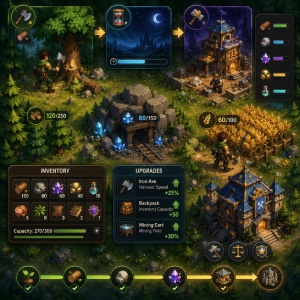
At their core, these systems are built around a simple loop: gather resources, wait for them to regenerate, spend what you’ve collected, then return with a stronger setup than before. That rhythm, repeated across dozens of sessions, is what makes harvesting feel like progress rather than busywork.
Renewable resources are the engine here. A forest tile that refills every four hours, a mine that resets at midnight – these timed cycles create natural pacing. Cooldowns and regeneration windows give players a reason to return on a schedule, building routine without demanding constant attention.
Inventory limits add pressure. You can only carry so much before you’re forced to make decisions about what to spend, store, or trade. That constraint turns a passive collection loop into something that actually requires thought.
Upgrades push the system forward. Better tools mean faster harvests or higher yield caps, so early inefficiency gradually gives way to satisfying output growth. Players feel the difference between day one and week three.
Why Timers, Regeneration, and Upgrades Keep Players Engaged
Momentum is what separates a system players return to from one they abandon after a week. Timers create exactly that: a reason to come back in two hours, not someday. When a resource node resets on a fixed cycle, players start planning around it almost automatically.
Passive regeneration works differently. Energy or stamina that refills while you’re offline rewards players for stepping away, which shapes session length without forcing it. Active harvesting, by contrast, demands attention and rewards it immediately.
Upgrades are where short-term actions connect to long-term goals. Faster collection speeds, expanded storage, access to rarer drop zones, or automated agents that gather while you’re idle – each one changes how a player thinks about their time. Unlocking an agent that harvests autonomously shifts your role from laborer to manager.
The strongest systems are readable. Players need to see what they’re working toward and understand why each tap or timer matters. Opacity kills motivation faster than difficulty ever could.
How Harvesting Loops Support Collectible Worlds and Web3 Entertainment
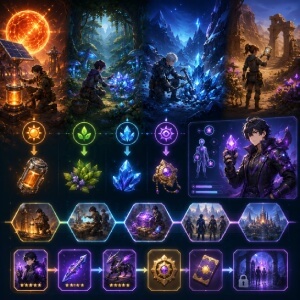
Simple interaction loops do something quietly powerful: they make a fictional world feel lived in. When a character harvests solar energy from a dying star, gathers crafting materials from a specific biome, or collects story-linked relics tied to a character’s lore, the world gains texture. The harvesting isn’t decorative – it’s the mechanism through which players actually inhabit a setting.
Character IP benefits especially from this. A recurring hero who “charges” abilities through harvesting creates behavioral identity. Players associate that character with specific actions, rhythms, and rewards.
Web3 entertainment extends this further. Collected resources, badges, NFTs, or access passes can represent participation milestones rather than financial instruments. Earning a rare item through consistent gameplay signals status and investment of time, not money. Gated experiences – exclusive story chapters, cosmetic rewards, community spaces – become meaningful because the player earned entry through engagement, not purchase. That distinction shapes how people relate to a digital world entirely.
Simple Loops Can Power Richer Player Worlds
Designed with intention, harvesting mechanics are far from filler. They set the pace of a session, mark progress in ways players can feel, and give the rest of a game’s systems something to anchor to. Resource collection, timed regeneration, and upgrade paths create a reliable rhythm that supports worldbuilding, character identity, and collectible-driven experiences without demanding complexity from the player. When a reward, badge, or unlockable item is tied meaningfully to that loop rather than dangled as a speculative incentive, it earns its place in the world. For designers and curious readers alike, the practical lesson is straightforward: simple loops work best when the rules are easy to read, the setting gives them context, and what you earn feels genuinely connected to how you play.
